1 | the boy at the beginning

In the beginning, there is a Garden; and in the center of this Garden, there is a pool surrounded on eight sides by a low wall of smooth white stone; and the pool is filled by a clear fountain that rises from deep within the marrow of things. A cut in one of the walls allows the fresh water to flow out, where it becomes a stream that waters the Garden.
In the morning, a boy comes to the pool and wades into its waters to catch the children who swim up from its depths, one after another. The boy is twelve years old…or seems to be, anyway, given his stature and the boyish features of his face. He wears long black swim trunks as he stands gazing into the depths of the pool, waiting. His warm skin is sun-soaked and his limbs finely muscled, as if he spends his days working hard outdoors.
And yet, none of the children will mistake him for another child when they look on his face for the first time. His eyes are young, but also ancient…eternal, but newly born. And when he comes to the pool in the morning, he carries with him a stout wooden walking staff that seems better fitted to someone much larger and older than he is.
Tall figures emerge from the morning mist that rises from the Garden, and they gather around the pool at a respectful distance. They are dressed in light-colored, flowing garments subtly ornamented with colorful stitching. Although they are as silent as soldiers in the calm before the battle, the light in their eyes betrays anticipation; they, like the boy, are waiting.
The boy looks intently into the waters of the pool and sees the reflection of his face…the curve of his cheek, the curls of thick black hair falling around his shoulders. He skims the palms of his hands over the surface of the water, gently stirring it.
And then, from the clear depths of the pool, here come the children.
They float upward on the fountaining current; some breach the water with a splash and a laugh, and others delicately push their faces through the mirrored surface. The boy catches the younger ones up in his arms, and offers the older ones his hand, helping them out. He greets each child in the formal way, touching each one on the cheek with the first three fingers of his hand as he speaks the child’s name; and when he does, the children realize they already know him, and in fact have known him all along.
When the boy has greeted a child, one of the tall watchers steps forward to meet that soul face-to-face for the first time. These are the Guardians; they are imposing figures, as tall and strong and finely formed as any Greek sculpture. Introductions are made, the formal greeting ritual repeated, and then the pair step back to watch as the boy catches the next child.
The children come one after another, boys and girls alike, of every race and nation, all of them wearing brightly colored swimsuits. Soon, the grassy slopes around the pool are crowded with children and their Guardians, and the gathering becomes festive. Each new arrival is greeted with clapping and cheering from the other children and their Guardians.
And once the new child has been properly greeted by the boy and the child’s Guardian, the other children reach out with warm, welcoming hands; each new arrival is a friend, after all, a new brother or sister.
At last, the boy looks around at the crowd of children and Guardians. “One more?”
“Yes!” they all say.
The boy nods, then bends over the water, skimming his hands across its surface. This time, a Nuristani girl shoots high up out of the water, then falls back with a splash and a laugh, and the boy laughs with her as he helps her to stand. She is sleek and long-limbed, and her swimsuit, which is as orange as nasturtium petals, seems to glow in the light of the new morning. Shining beads of water adorn her face.
The others around the pool are cheering for her, but she can’t take her eyes off the boy; she smiles at him strangely, wondering how she knows him, and gently takes the fingers of his free hand in her own.
“I greet thee and honor thee, Anesa Selah,” the boy says, gently touching three fingers to her cheek. A surge of warmth enters her through his touch, and with it, a deep sense of connection, as if they had been friends forever. And then, the lights come on in her eyes, and they widen; now she recognizes him. She raises her hand to her mouth in surprise, and then reaches out to touch his cheek with three fingers.
“And I greet thee and honor thee, You Who Keep the Story,” she says. She holds her hand there for a moment, then throws her arms around his neck. “Thank you,” she whispers.
He returns the embrace. “Welcome home, Anesa.”
Then the other children surge around her, murmuring words of welcome and placing their warm hands on her. With each touch, she feels a pulse of warmth, and with it comes the epiphany of a name, a face, and an invitation to friendship.
One of the Guardians moves forward: an elegant, dark-skinned woman with the most elaborately dressed hair Anesa has ever seen, and golden bands around her wrists. Her flowing garments are adorned with signs and symbols in blue and gold thread. The woman seems radiant, as if she is lit from the inside, and her eyes shine with a thousand stars. As she draws near, the other children make way, and then she is crouching down before Anesa. She even smells beautiful, Anesa thinks, like henna blossoms from the vineyards of En Gedi.
“I am Ahva Maathai Teth-hū, one of the Ilaliyaha, and I have been your Guardian for all your blood-and-bone days. I greet thee and honor thee, Anesa Selah,” the woman says, touching Anesa’s cheek.
Anesa tentatively returns the greeting, smiling shyly. When she touches Ahva, she feels it again—the same surge of warmth and sudden ease and familiarity, as if she is just recognizing a friend she hasn’t seen in years.
She pulls her hand back and laughs. “Does that always happen?” she asks.
“Yes!” shouts a girl in the crowd with long braids, and everyone laughs, and others echo her response, nodding.
Anesa lifts her arm and examines it curiously, then looks down at the rest of her body. “I am young again,” she notes matter-of-factly. “When I died, I was sixteen, and now I…or my body…is like a girl’s again.”
“That’s nothing, honey,” says a willowy boy with a broad smile and twinkly eyes. “I was eighty-six when they shoveled me under the earth…and now, look at me!”
“I have you beat—ninety-nine!” the pigtailed girl next to him says. “Just shy of a century, but I don’t mind.”
“Well, I just showed up here,” says a little boy with white-blond hair. “I died so young, no one ever even gave me a name. But now I have a name: Ha’ana, which means, ‘Here I am!’ because those were the first words I said when I woke up. The first words I ever said at all, I guess.”
Everyone is chattering with his or her neighbor now, comparing their blood-and-bone lives.
Anesa shakes her head in wonder. “What is this place?” she asks the boy.
“This is the Garden at the Beginning of Things,” the boy replies. “And you have a body that is good for beginnings…and for the very large playground that you’ll find down that path,” he says, pointing. “Past the fountain and the, um…baby elephants?… around the curve and along a ways.”
The mist has entirely lifted now, revealing the Garden in its full glory: brickwork paths that wind among tall, majestic trees laden with flowers and fruit, mounds of exotic flowers, waterfalls and fountains, wind chimes and whimsical sculptures. And yes, three baby elephants seem to be playing by the path, cantering around in some elephanty game of tag.
“The playground really is amazing,” Ahva tells the girl. “You won’t believe your eyes…or your ears, or your tongue. Would you like me to show you?”
“Is it playtime now?” asks a loud little boy with straight, jet-black hair.
“Yes,” agrees the boy with the ancient eyes. “It’s long past playtime. Go with your Guardians; they will show you the playground. I will come, too, in a while.”
At this, all the children holler, scampering off down the path. Their Guardians follow alongside them, easily keeping up at a walking pace.
But Anesa hesitates. She looks back at the pool, and then to Ahva and the boy.
“There was another one behind me, a boy…shouldn’t we wait for him?” She looks to the boy questioningly. “Or isn’t he coming?”
The boy nods solemnly. “I expect he will arrive…eventually. Many children turn back.”
She nods, looking troubled. “I wouldn’t have come without your help. Is he lost, then?”
The boy cocks his head. “He would say he is finding his own way, in his own time.”
The girl bit her lower lip; the boy was lost, then. “Can’t you help him…like you helped me?”
The boy ducks his head and smiles. “That depends. You welcomed our help. Not everyone does.” He glances around toward the only other Guardian remaining near the pool, other than Ahva. “What do you say, Iridius a’ Laamenhi Ocoar’en?” the boy calls. “Will our lost friend ask for our help?”
Like Ahva, Iridius is huge, with bronze skin that seems to glow in the morning light. His thick arms and legs and his broad chest suggest great strength, even as his blue, star-filled eyes speak peace. His garments shine with stitched blue and gold symbols and ornaments. He approaches them and bows his head.
“I greet thee and I honor thee, You Who Keep the Story,” he says to the boy. Then he turns to Anesa and Ahva, bowing his head and offering them the greeting of honor, which they return.
“And I greet thee and I honor thee, Iridius,” the boy says, reaching out to press three fingers against the palm of the man’s hand, his cheek being out of reach.
“Yes, I believe the boy will seek our help,” Iridius says at last. “Although he has only begun on the path of clarification, already he has grown in strength and wisdom.”
“Maybe I can help him, too?” Anesa asks.
The boy seems pleased. “Of course,” he says. “We will help him together.”
Anesa nods once, glad. “Good.”
“Do you see how this girl shines?” Ahva says to Iridius. “Someday she must tell you the story of how she sacrificed herself for the sake of another.”
“I have heard how you shone on that day,” Iridius says, addressing Anesa. “But I look forward to hearing the story from your own mouth.”
“Should we catch up with the others?” Ahva asks the girl. “Your mother and father and sisters are waiting for you.”
Anesa’s eyes widen, and her hands fly up to her mouth in surprise. “Really? Really? But…how is that possible?”
“Come and see,” Ahva says. “The world is so much larger than you had ever imagined.”
For a moment, Anesa is overwhelmed by a frisson of happiness. Were she not in the habit of keeping two feet on the ground, she might rise into the air, she feels so light—so unburdened. And not only is the world larger than she had imagined, but her mind seems to have grown with it. Her thoughts are sharp and lucid, as if she has finally emerged from a heavy fog into the light, and her perception of the world is suddenly unbound. No longer does the world come to her a piece at a time; now she seems to take it in all at once, and not only through her senses, but in another way, too. Something of the boy—the One Who Keeps the Story—and Ahva, and the other children, has lodged inside her heart, which feels full to overflowing.
No wonder there is so much laughter here, she thinks.
She and Ahva do not run down the brickwork path, but take their time; they pause, for instance, to caress the heads of the baby elephants, and to listen to the music of falling water in the stream.
“What is it like, waking up here?” Ahva asks Anesa.
Her answer comes readily, almost without thought. “It feels like I have come home,” she says.
* * *
The boy and Iridius watch the girl and her Guardian go.
“That one does shine,” the boy says, meaning Anesa.
“Yes,” says Iridius. “All the children shine, each in their own way.”
The boy nods, then wades into the pool. The light that shines on the surface dances around him as he stirs the waters once again. He is looking for the lost boy.
“You came home, Iridius a’ Laamenhi Ocoar’en, to tell me about this lost boy—Jonah Tobias Fisher—because he is more than just lost, isn’t he?”
“That’s true,” Iridius says. “His situation is very…unusual. After he died, he turned away from the Light, as we thought he might.”
“He is shadowed, but not more than most of the children.”
“No, not more than most. I enlisted the aid of his grandfather, your servant Cosmas Alexander Zograffos—”
The boy lifts his head, delighted. “Wait, Cosmas Zograffos, the famous house painter? The one who did the red house at 1798 Franklin Street? I love that house.”
Iridius is amused. “The very one, my friend—although I am not aware of any other who goes by that name. He and I rescued the boy from his shadowlings, at least for the time being, and set him on the way of clarification—the long way around, as Cosmas says. With the help of his grandfather and some other friends, he had been coming along fairly well, growing in strength and wisdom.”
“All right,” the boy says. “But then…?”
“But then, he made a detour to the Darker Reaches…”
The boy’s eyebrows shoot up.
“…in order to rescue his father, Saul Elias Fisher; but then, the boy’s people used their medicine to draw him back into his breath-and-bones body.”
The boy winces. “And now?”
“And now he is in a hospital, dealing with all the usual aftereffects of an aborted death…but, also…he can see into the Overworld. Not everything, of course, but all his entanglements: me, his grandfather…his shadowlings.”
“And the Shadow itself.”
Iridius nods. “And the Shadow itself, which contrives to use the situation to its advantage.”
“Oh, shadow, shadow, empty bones and hollow rattle,” the boy says, quoting an old poem. “The boy must be afraid.”
“He is freaked out, as he himself put it.”
“Uh huh. Freaked out.”
“Yes…which, of course, makes it more difficult to help him. In short, he sees much as an angeling would—but only with the senses of his blood-and-bones body, not with his heart, nor with the wisdom or understanding of an angeling. And…he still clings to his shadowlings.”
“Iridius, my friend,” the boy says, “it is perhaps an understatement to call his situation ‘very unusual,’ although I can think of a handful of others like him.”
The Boy Who Keeps the Stories stares into the pool, watching the light play on its rippling surface. He is thinking that he would like to dive to the bottom of its waters to find the lost boy and bring him home, if he could. But it is impossible, by definition, to bring a shadowed child home; the shadowlings must be drowned first, and that is a choice that belongs to the child alone. The problem here is the same as it always is: How do you help a shadowed child decide to drown his shadowlings when he believes they are the foundation of his being? And how do you help the child when he doesn’t want your help—when he wants to make his own way? The problem is the same, but the solution is different every time.
“Are you thoughtfully considering our dilemma, or merely pausing for dramatic effect?” Iridius finally asks.
A quiet smile creeps onto the boy’s face. “Pausing for dramatic effect, of course. Let’s walk in the cool of the Garden. Maybe you should tell me this boy’s story from the beginning. Or from his death, anyway.”
“You, the One Who Keeps the Story, want me, Iridius a’ Laamenhi Ocoar’en, a mere Ilaliyaha—”
“Yes,” the boy laughs, playfully splashing Iridius.
“—to tell you a story?” Iridius finishes.
“Yes, I do.” The boy grins at the Guardian as he makes his way out of the pool.
“Surely you already know his story, my friend,” Iridius protests. This is their ritual, the game they play.
“You know I don’t like to read ahead. Besides, I don’t know the story the way you will tell it, Iridius.”
“Very well,” Iridius concedes. “I will tell you a few chapters in the story of Jonah Fisher, beginning with his death.”
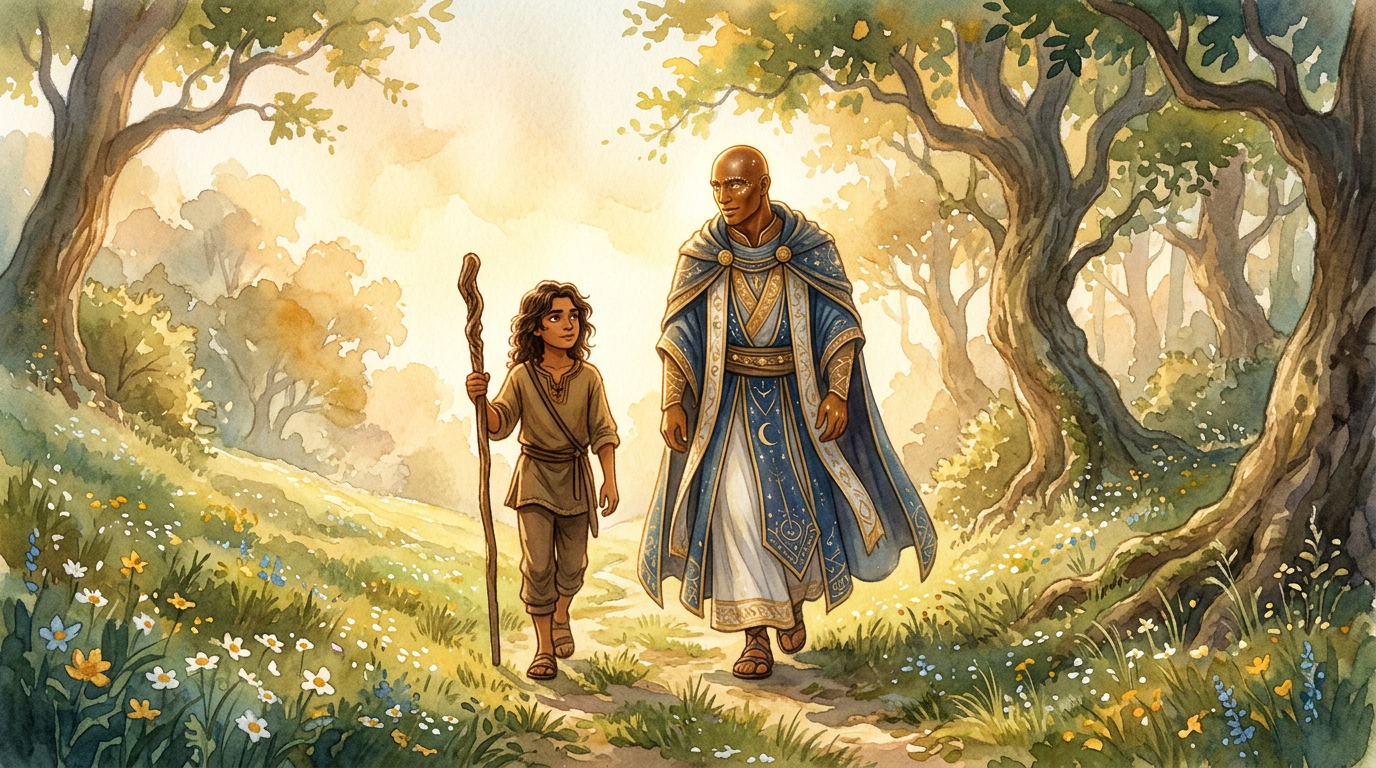
“Good,” says the boy, clapping the Guardian on the arm. He stoops to retrieve his wooden walking staff from the grass at the edge of the pool. “Let’s walk the Garden as you tell the story.”
And so they walk, up a grassy slope and into a woodland speckled with little white flowers, and every shadowed place they go is gently illuminated by the light they cast.
“This is the story of how Jonah Tobias Fisher died, traveled to the Darker Reaches in the hope of rescuing his father, and subsequently returned to the shadowlands with the gift of the angelings, but not the wisdom or understanding to go with it,” Iridius says.
He pauses. Where to begin? Every story, he knows, shares the same beginning, because every story is only a collection of interwoven threads in the tapestry that makes the one Great Story. Good storytellers know better than to chase a beginning all the way down to those deep roots, though. Good storytellers find a jumping-off place of their own, and make it shine.
He mulls over all the six thousand, two hundred and sixty days of Jonah’s life, trying to find a beginning; but finally, he decides to simply begin at the end—the day Jonah Fisher dies.